
YOGA THERAPY TRAINING
Supports health and transformation processes
with a personalized, therapeutic approach
based on the tradition of yoga

YOGA THERAPY
Yoga Therapy (Yoga Cikitsa) is a process of self-empowerment in which the student, guided by a yoga therapist, develops a personalized and constantly evolving practice. This approach is not limited to treating illness from a multidimensional perspective, but also seeks to alleviate suffering in a progressive, respectful, and complementary way.
Suffering is part of human nature. From birth, we are exposed to various imbalances that can manifest on the physical, energetic, mental, psychological, or spiritual planes.
In this sense, Yoga Cikitsa presents itself as an effective tool for releasing what prevents us from connecting with our true essence. For the yoga teacher who wishes to deepen their personal practice, this path offers an exceptional opportunity to explore the tools of yoga more thoroughly and develop a more intimate understanding of themselves.
This process allows us to recognize and dissolve the obstacles that distance us from our purest, most luminous, and essential nature. By walking this path ourselves, we acquire the experience and resources necessary to accompany others on their own journey of transformation.
Dr. Chandrasekaran and Dr. Siddhartan will be jointly responsible for providing the training, contributing their experience and knowledge in the field of Therapeutic Yoga.
The seminars will take place at Tidore Yoga Academy in Zarautz, and will be organized into several meetings distributed throughout the training program, complemented by an intensive period of supervised practice at the end of the training in Chennai, India.
This structure will allow participants to progressively integrate the content, delving deeper into both the theory and the practical application of Yoga Cikitsa.
Doctors Dr. Chandrasekaran and Dr. Siddhartan will jointly provide the training, accompanied by Esther, who will do the translation.
Why study Yoga Therapy?
1. Deepen your personal practice
Yoga Therapy invites you to go beyond physical practice. It helps you observe yourself, understand your own patterns, and consciously work on your balance at a physical, mental, and emotional level.
2. To understand the human being in a holistic way
You learn to see the student as a whole: body, energy, mind, and emotions. This allows you to understand the origin of imbalances, not just their symptoms.
3. To accompany processes in an individualized way
Unlike a general class, Yoga Therapy is tailored to each individual. Studying it gives you the tools to design specific practices according to each student’s needs.
4. Expand your tools as a yoga teacher
Yoga Therapy does not seek quick or invasive solutions, but rather progressive processes that help alleviate suffering and improve quality of life
5. Reduce suffering in a respectful manner
If you already teach, it allows you to greatly enrich your classes and the way you support students. You gain resources to work with injuries, stress, anxiety, or other conditions safely and consciously.
6. Connect with your essence
Through this path, you begin to recognize and let go of what distances you from your most authentic nature, generating greater clarity, stability, and well-being.
7. Compatible with other health systems
Yoga therapy is fully compatible with traditional medicine and other therapies. It can be approached as a primary path or as a complement to other treatments. By working in harmony with nature, it does not interfere with disciplines such as physiotherapy, osteopathy, psychology, psychiatry, acupuncture, or homeopathy, as its methods are non-invasive. Furthermore, it can also be integrated as a support for practice in group yoga classes.
8. Develop a more conscious and human perspective
It not only changes your practice, but also the way you relate to yourself and others.
In summary, studying Yoga Therapy is an opportunity to grow personally and, at the same time, acquire real tools to accompany others in their own transformation processes.
Where does the tradition of Yoga Therapy come from?
The Yoga Therapy tradition has its roots in the lineage of Tirumalai Krishnamacharya, considered one of the great masters of modern yoga, and continues through his son and disciple T. K. V. Desikachar.
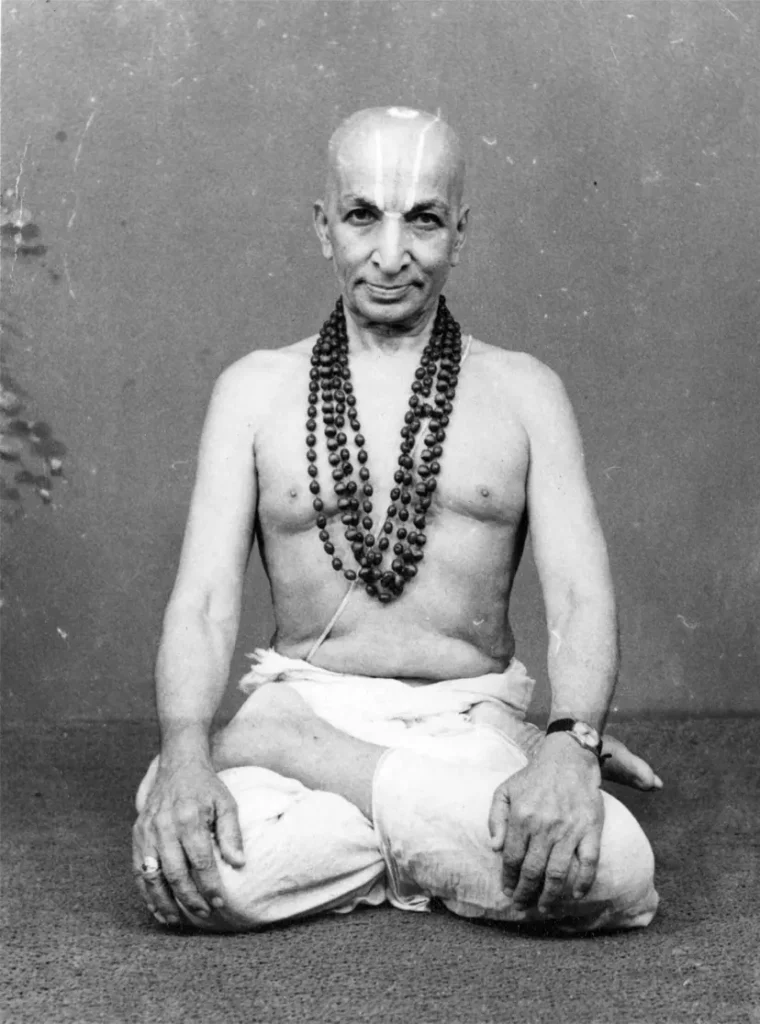
The origin: Krishnamacharya
Krishnamacharya developed a profoundly adaptive teaching method, where yoga should be adjusted to the person, not the other way around. His approach already incorporated what we understand today as Yoga Therapy: an individualized practice that takes into account the condition, age, context, and needs of each student.
For him, the goal of yoga was not only physical, but to alleviate suffering and help the person to live with greater clarity and balance.
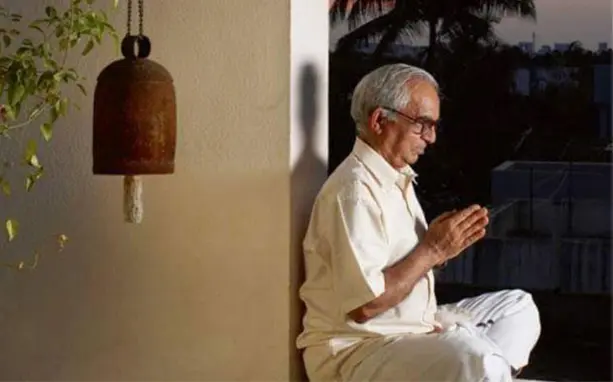
The evolution: Desikachar
T. K. V. Desikachar collected and systematized these teachings, developing Yoga Therapy (Yoga Cikitsa) in a more structured way. He founded the Krishnamacharya Yoga Mandiram in Chennai, where he integrated yoga with knowledge of modern medicine and health sciences.
Desikachar emphasized:
- Individual Adaptation (Viniyoga)
- The importance of breathing as a therapeutic tool
- The progressive support of the student
- The close relationship between teacher and student
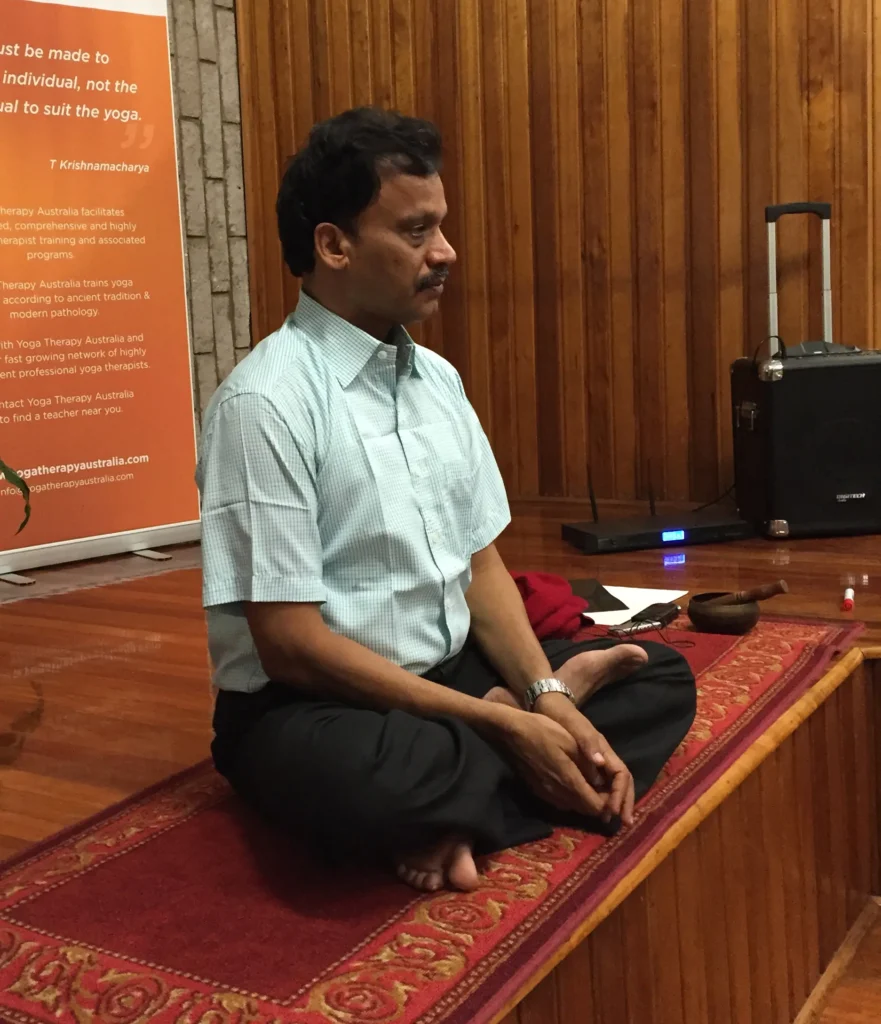
Dr Chandrasekaran
Dr. Chandrasekaran is part of the Yoga Therapy tradition that descends directly from the lineage of T. K. V. Desikachar, being one of his students and successors in the therapeutic field.
Trained at the Krishnamacharya Yoga Mandiram in Chennai, Dr. Chandrasekaran integrates classical yoga teachings with his medical knowledge, keeping alive the essence of the approach passed down by Desikachar.
From this perspective, Dr. Chandrasekaran represents the continuation of a line in which yoga is understood not only as a practice, but as a profound means of care, transformation, and reduction of suffering.
His teaching maintains the spirit of this lineage: a respectful, precise, and person-centered approach, where each practice becomes a unique tool at the service of the student.
DATES OF UPCOMING COURSES
Different profiles and extensive knowledge in different fields, all with a single goal: to bring you closer to the path of yoga. Whether your objective is to learn to teach, improve your teaching skills, or simply discover new depths in your practice, we have a training programme for you!
DATES OF UPCOMING COURSES
From May 1st to 12th, 2027
ONE-DAY TRAINING
Full time: 9:00 a.m. to 5:30 p.m.
. 12:00 – 12:30
asana practice
DETAILS
Online mode
Principles and theory classes taught live via Zoom, according to Indian time (IST).
All sessions will be recorded, so you can follow the training both live and later.
The classes include Spanish translation.
Tarifas y condiciones
Price per module:
750€
Place reservation:
300€
Certification
This training is endorsed by the Indian Yoga Association and the IYTA (International Yoga Teachers Association)
- The price does not include travel or accommodation.
- We can help you arrange accommodation through our partners in Zarautz and the surrounding area.
- The final module will take place in India, where we will assist you in organizing your stay and flights.
For more information and registration, contact tidoreyogaacademy@gmail.com